
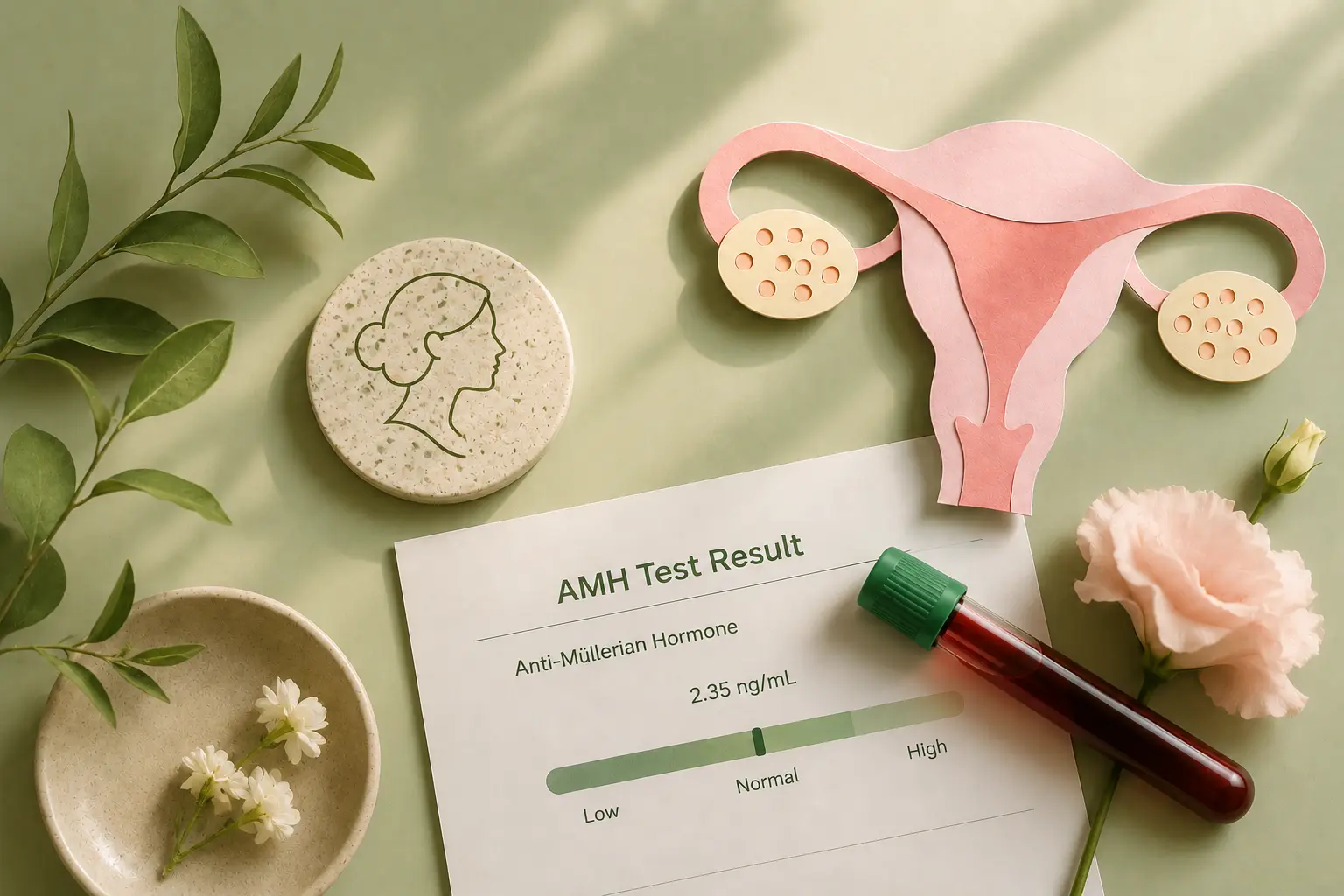
You got your AMH number back and now you’re staring at it, wondering if it’s good, bad, or somewhere in between, and honestly, that confusion is completely understandable. Few fertility tests get misread as often as this one. AMH offers real, useful information, but it’s routinely stretched to mean far more than it actually does. Getting clear on what this number can and can’t tell you changes how you interpret your own result entirely.
What Is AMH?
Anti-Müllerian hormone, AMH for short, comes from cells surrounding the follicles developing inside your ovaries. Measuring it gives a window into your remaining pool of recruitable follicles, which is why it’s become a standard part of assessing ovarian reserve, especially useful when fertility treatment is on the table.
What Your AMH Result Actually Tells You
Broadly speaking, AMH helps predict how your ovaries are likely to respond to stimulation during IVF. Higher levels tend to point toward a larger potential response, lower levels toward a more modest one. But that’s a general pattern, not a fixed rule, how it plays out depends heavily on your age, your specific clinical situation, and even which lab assay was used to run the test.
What Your AMH Result Doesn’t Tell You
This is the part that gets misunderstood constantly, so it’s worth spelling out clearly. AMH is not a measure of egg quality. It can’t reliably tell you whether you’ll conceive naturally, exactly how many eggs you have left, how good those eggs are, whether a future embryo will be chromosomally normal, precisely when you’ll hit menopause, or whether IVF will end in a baby. It’s a piece of the puzzle, not the whole picture.
Age Tells a Different Story Than AMH Does
Age remains one of the strongest predictors of egg quality and overall reproductive potential, and it measures something entirely separate from what AMH measures. Two women with an identical AMH result but a real age gap between them can face very different fertility outlooks. In fact, a younger woman with low AMH may have fewer eggs on paper but better average egg quality than an older woman showing the same number.
If Your AMH Comes Back Low
A low result signals reduced ovarian reserve relative to what’s typically expected for your age, and it often predicts fewer eggs collected during stimulation. But low AMH is not the same as zero chance. Plenty of women with low AMH still ovulate regularly and conceive naturally without any assistance.
If Your AMH Comes Back High
A higher result usually points to a larger follicle pool and shows up commonly in women with PCOS. In a fertility treatment context, high AMH tends to predict a stronger response to stimulation, information your clinician can use to fine-tune medication doses and reduce the risk of complications like ovarian hyperstimulation syndrome.
Where Antral Follicle Count Fits In
AMH rarely stands alone; it’s usually read alongside the antral follicle count, or AFC. This is measured through ultrasound, counting the small follicles visible in the ovaries at a specific point in your cycle. Together, AMH and AFC give a much fuller picture when planning ovarian stimulation than either measurement could offer alone.
Who Actually Benefits From This Test?
Ovarian reserve testing tends to be most useful for women planning fertility treatment, considering egg freezing, with a family history of early menopause, who’ve had ovarian surgery in the past, living with endometriosis or ovarian endometriomas, recovering from certain medical treatments that affect ovarian function, or simply thinking seriously about their reproductive timeline. Ideally, the result comes with proper counselling attached, since a number without context is easy to misread.
AMH’s Role in Egg Freezing
For anyone considering egg freezing, AMH helps estimate roughly how many eggs stimulation might produce. What it can’t do is guarantee how many mature eggs will actually end up frozen, or predict whether those eggs will eventually lead to a live birth. Your age at the time of freezing still carries enormous weight here, arguably more than the AMH number itself.
AMH’s Role in IVF
During IVF, AMH helps estimate how your ovaries will likely respond and allows stimulation to be tailored to you specifically. A low result might reset expectations around egg numbers, while a high result might call for a more careful approach to avoid overstimulation. Either way, no single AMH result, high or low, decides whether IVF will actually succeed.
Frequently Asked Questions
No, not at all. Low AMH affects expected egg numbers, not your ability to conceive naturally.
Not necessarily. It mainly reflects ovarian reserve and likely response to stimulation, not natural fertility overall.
No, it doesn’t. Age gives a far better indication of expected egg quality than AMH ever will.
Not with the precision you’d want. It can’t pinpoint an individual woman’s menopause timing accurately.
No, it’s most valuable when there’s a clear clinical or fertility-planning reason behind it, paired with proper interpretation.
When to Make an Appointment
If your reproductive timeline is on your mind, whether that’s egg freezing, planning pregnancy, or exploring fertility treatment, ovarian reserve testing can form a useful part of a broader fertility evaluation. The real question isn’t just “what’s my AMH”; it’s what that number actually means once it’s read alongside your age, your ultrasound findings, and what you’re hoping for.