
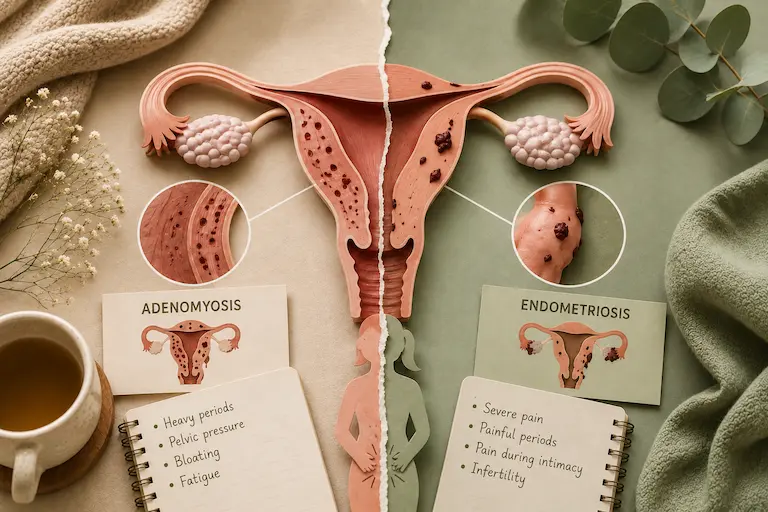
Painful periods, pelvic pain, and fertility struggles show up in both adenomyosis and endometriosis, which is exactly why so many women get the two mixed up. They’re different conditions with different treatment paths, and some women live with both at once. Knowing which one you’re dealing with changes what happens next.
What Is Adenomyosis?
Adenomyosis develops when endometrial-type tissue grows into the muscular wall of the uterus itself. Over time, this can enlarge the uterus and make it tender, and it’s a common driver of heavy, painful periods.
What Is Endometriosis?
Endometriosis is endometrial-like tissue growing outside the uterus, on the ovaries, pelvic lining, bowel, bladder, or the tissue behind the uterus. It can trigger inflammation, scarring, and adhesions well beyond the reproductive organs.
Symptoms: Where They Overlap (and Where They Don’t)
Adenomyosis tends to show up as heavy periods, painful periods, pelvic pressure, chronic pelvic pain, pain during intercourse, and an enlarged or tender uterus.
Endometriosis tends to show up as severe period pain, chronic pelvic pain, pain during or after intercourse, cyclical bowel or bladder symptoms, ovarian endometriomas, and difficulty conceiving.
The overlap is exactly why symptoms alone rarely give a clear answer. Imaging is what separates the two.
Can You Have Both?
Yes, and fibroids can join the mix too. If your symptoms are persistent or severe, a thorough scan matters more than guessing from symptoms alone.
How Ultrasound Diagnoses Adenomyosis and Endometriosis

A high-quality transvaginal ultrasound, performed by an experienced sonographer, can pick up the characteristic features of adenomyosis and identify ovarian endometriomas or signs of deep infiltrating endometriosis. At Oasis Imaging, our pelvic ultrasound and dedicated endometriosis ultrasound (DIE scan) are built specifically for this kind of detailed pelvic assessment, with longer appointment times so nothing is rushed.
A normal ultrasound doesn’t fully rule out superficial endometriosis, and some cases need further specialist review, but for most women, ultrasound is the first and most useful step.
Fertility and Family Planning
Both conditions have been linked to reduced fertility, though the impact varies a lot between individuals. If you’re planning IVF or a frozen embryo transfer, imaging of the uterine cavity matters. Our saline sonography and HyCoSy scans help assess the uterine cavity and fallopian tubes before fertility treatment begins.
Frequently Asked Questions
Neither is definitively worse. Both range from mild to severe and affect every woman differently.
A specialist ultrasound can identify adenomyosis, ovarian endometriomas, and some forms of deep endometriosis, though imaging does have limits.
Adenomyosis has been associated with poorer reproductive outcomes in some
populations, but this does not mean IVF will be unsuccessful.
No universal treatment applies to every patient. Management should be individualised
according to the extent of adenomyosis, symptoms, reproductive history and fertility-
treatment circumstances.
When to Book a Scan
Consider booking an assessment if you’re experiencing severe period pain, heavy periods, persistent pelvic pain, or pain during intercourse. If you’ve already been diagnosed and are planning pregnancy, imaging alongside your fertility specialist helps build the right treatment plan.